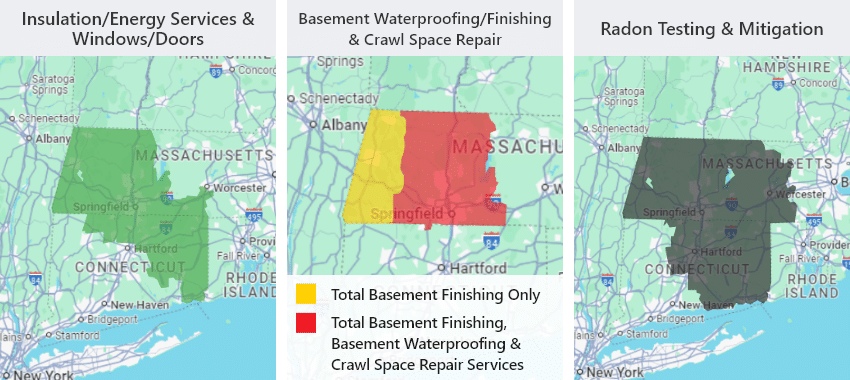
Proudly Serving Western Massachusetts, Northern Connecticut, and surrounding areas.
Fogarty's Home Services Before & After Photos
Click on a photo to enlarge.
Air Sealing a Basement to Protect From Moisture in West Springfield, MA


This homeowner called us because he purchased a home near the water and wanted to re-do the basement. The homeowner wanted to create a moisture barrier in the basement before continuing with the total basement finishing project.
Our Building Science Specialist carefully evaluated the basement and concluded that the best option was to air seal and insulate the rim joist with closed-cell, Spray Foam Insulation. We offered a simple and affordable solution to effectively solve the problem for the long term. We fix uncomfortable homes!
Reducing Ice Damming in West Springfield, MA


This homeowner in West Springfield, MA called us out to their home to see what could be done for the prevention of their ice damming issues they had been experiencing. We conducted our Full Home Energy Evaluation and noticed that their attic had old, nasty fiberglass insulation. Since fiberglass insulation is light and fluffy it allows air to travel through it, not making as the best insulator. We knew that we needed to remove and replace this insulation with more efficient material.
For this specific attic, we needed to create an insulation catwalk so that the HVAC system was still reachable. We install our expanded polystyrene SilverGlo foam board insulation across the ceiling joists. SilverGlo insulation boards are infused with graphite, increasing the insulation value by 24%. WE secure the SillverGlo with 5” screws and 3” washers. Dams made of Oriented Strand board are installed to keep insulation off catwalk. These Oriented Strand boards are two times stronger than plywood! After this, TruSoft cellulose insulation is blown into attic, also covering any sace beneath the catwalk is filled. Thanks to Dr. Energy Saver by Eco Energy Solutions, the ice dams in this home will be drastically reduced due to new insulation and air sealage of the attic!
SilverGlo™ Attic Insulation in West Springfield, MA


Vented attics are hostile places - 30˚F in winter and 125˚F in the summer. They are very bad places to store things, and the worst place to locate ducts because they are the extreme opposite temperature as the air in the ducts that you paid to heat or cool. The attic floor (your ceilings), allow air from inside the house to leak into the attic where it is lost. For each cubic foot of air that leaks out, a cubic foot of air from the outside enters the bottom of the house, making your lower levels cold and drafty. Heat from the house in the attic melts snow on the roof where it refreezes at the eaves causing destructive ice damming. In the summer, the sun heats your roof to 160˚F, which radiates to the attic and then to your ceilings and rooms. The problem, heat loss to the attic from house and ducts in winter, and heat gain in summer, uncomfortable rooms, more drafts upstairs and downstairs, higher fuel/electric bills.
The Solution, SilverGlo™ EPS foam insulation board with graphite is installed on the underside of your roof deck. The graphite gives it superior R-value and a foil face on both sides reflects heat out in summer and back in during winter. The roof is still vented, kept cold in winter to prevent ice damming. In summer, excess heat is vented out. No harsh chemicals are sprayed in your home, like spray foam. The attic is now part of the conditioned space in your home, and ducts in the attic are no longer in a hostile environment. Your attic is clean, less dusty and suitable for storage. You can even finish your attic! Results - Your home is less drafty, warmer in winter and cooler in summer, lower fuel and electric bills, and less dust.
Finishing a Home Movie Theater in West Springfield, MA


When this homeowner in West Springfield, MA called us, it was in regards to a special request. She wanted to make a home movie theater in the basement for her husband. Of course, Fogarty's Home Services was up to the task.
When we arrived, we were met with a semi-finished basement. In the area that they wanted to put the home theater, all you can really see were the bare concrete floors, gray walls, and a projector screen.
Luckily, our team was able to put in modular, ThermalDry™ plank flooring. In order to keep this as dark as possible, they chose the darkest possible color -- espresso. The flooring is waterproof and easy to clean, meaning that if someone spills soda, it will be okay. We also were able to install black linen drop ceiling tiles to complete the look.
This is no longer a bare, cold room -- it has turned into a theater that their family will be able to utilize for decades, and is something that will add value to their home.
Installing a SunHouse™ Window Enclosure in West Springfield, MA


This homeowner in West Springfield, MA called us hoping that we would be able to help him. He had rain coming into his basement through his window wells. When our Home Comfort Specialist came out to the home, he noted that the window wells had ill-fitting covers and, additionally, did not let light into the basement.
We had the perfect solution for this customer. We were able to help him by installing a SunHouse™ basement window enclosure with a drainage system (not pictured) to prevent flooding. SunHouses™ are sturdy and keep rain and leaves out due to their clear cover, and the bottom reflects natural light into the basement due to its light color.
Now, this homeowner is much happier with their window wells!
our service area
We serve the following areas
- Adams
- Ashley Falls
- Becket
- Berkshire
- Blandford
- Cheshire
- Chester
- Cummington
- Dalton
- Drury
- East Otis
- Glendale
- Granville
- Great Barrington
- Hinsdale
- Housatonic
- Lanesborough
- Lee
- Lenox
- Lenox Dale
- Middlefield
- Mill River
- Monroe Bridge
- Monterey
- North Adams
- North Egremont
- Otis
- Pittsfield
- Plainfield
- Richmond
- Rowe
- Sandisfield
- Savoy
- Sheffield
- South Egremont
- South Lee
- Southfield
- Stockbridge
- Tyringham
- West Stockbridge
- Williamstown
- Windsor
- Worthington
- Barkhamsted
- Burlington
- Colebrook
- North Canton
- Riverton
- West Hartland
- Winsted