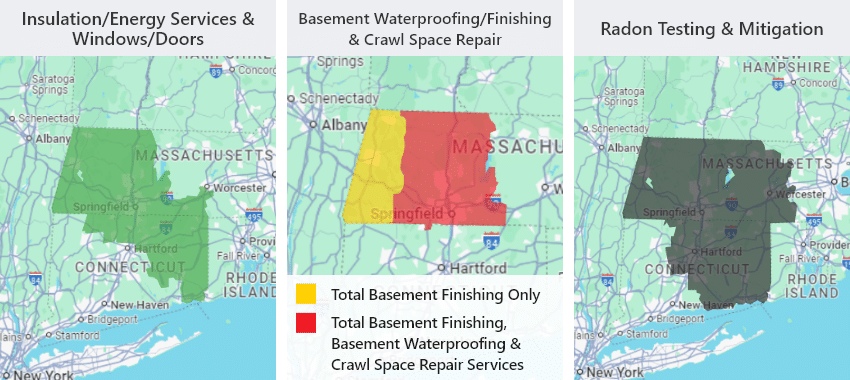
Proudly Serving Western Massachusetts, Northern Connecticut, and surrounding areas.
Insulation Services Before & After Photos
Click on a photo to enlarge.
Removing Old Insulation in South Deerfield, MA


This homeowner in South Deerfield, MA called us wanting his old attic insulation removed and replaced.
Removing old blown-in insulation is not an easy task. When you have fiberglass batts, you are able to simply bag them up and dispose of them. However, with blown-in, you need a very powerful vacuum to remove all of the loose insulation.
In order to achieve this, our team at Fogarty's Home Services took a large hose up to the homeowner's attic. We then started vacuuming up the blown-in, making sure that we got into every hard-to-reach area.
Now, the attic is prepared and ready for air sealing and fresh insulation!
Install Structural Cover Over Sloped Stairwell Ceiling in West Springfield, MA


The owner of a beautiful brick home in West Springfield, MA contacted Fogarty's Home Services to help insulate his home. He was experiencing cold drafts and wanted to resolve this issue. One of our Home Comfort Specialists discovered that there were sloped stairwell ceilings that were open to the attic when conducting this homeowner's free home energy evaluation. When a stairwell has a sloped ceiling forming a big triangular space that is open to the attic, it creates a heat loss (winter) and heat gain (summer) problem in the home. The sidewalls of the open well into the attic are hard to insulate and often leak air from the walls of your house into the attic. The stairwell ceiling radiates heat from the house in to the attic, and from the hot attic to the house in the summer. Insulating the attic properly is not possible with this big stairwell hole in it. Fogarty's Home Services installed a cover made of wood over this stairwell at the attic floor level. Appropriate framing and wood sheets were used. The cover was sealed with expanding polyurethane foam to make it airtight. Blown insulation can now be installed over the attic floor and the stairwell cover. The sturdy cover doesn't pose a fall hazard if someone crawls into the attic in the future. Now, this happy customer is reporting less air leakage, less unwanted heat loss and heat gain, and the attic can be insulated properly.
Insulating Kneewalls in West Springfield


The second floor of a Cape suffers from inadequate insulation, and air leaks from the soffits into poorly insulated kneewall spaces. This results in cold drafty rooms in winter that are harder than necessary to heat, and hot rooms in the summer as roof heat radiates in unchecked. Kneewall spaces are dusty and too cold or hot which is unsuitable for clean storage.
First, our SilverGlo™ foam insulation panels are installed on the bottom of the rafters in the kneewall spaces and the ceiling joist bays are blocked and sealed with foam to stop air leakage. Then the roof slopes are dense packed with TruSoft™ cellulose insulation to stop air flow and insulate. Finally, the flat ceiling is insulated with TruSoft™ cellulose insulation.
Insulating an Attic in Chicopee, MA


This homeowner in Chicopee, MA called us with issues he was having with his energy bills being extremely high. He had original insulation from when the house was first built -- meaning the blown-in fiberglass insulation was over 50 years old and showing its age! We were able to help this customer by re-insulating his attic. We first sealed the many various points where air in his home was leaking into the attic. We then sealed and insulated other spots in his attic that were more tricky. We then replaced that insufficient fiberglass with blown-in TruSoft™ cellulose insulation -- keeping his energy bills lower and his home more comfortable.
Insulate & Air Seal Drafty Kneewall in Enfield, CT


The owner of this Enfield, CT home reached out to Fogarty's Home Services because her home was feeling drafty and cold. After completing her free home energy evaluation, we found that one of the contributing factors to this discomfort was a kneewall space in her attic that wasn't properly insulated. A kneewall space is created when a finished room is built within a sloped roof. A short wall called a "kneewall" forms a triangular space which mar or may not be accessible with a short door or access panel. The floor of the kneewall space forms the ceiling of the room below it. The floor and kneewall space side with exposed fiberglass batts. Since fiberglass does not stop air flow, the insulation does next to nothing to air seal and insulate. The floor of the upper level, the ceiling of the lower level and the kneewall are all cold in winter and hot (from radiant roof heat) in the summer. The kneewall space is not suitable for storage since it is dusty and very cold or hot. Fogarty's Home Services installed blocks of SilverGlo™ foam insulation between the ceiling joist bays. Outside the blocks, the surface of the ceiling was sealed with sprayed foam or SilverGlo™ foam. (Fiberglass insulation may be installed on top). SilverGlo™ foam insulation is installed under the rafters up to the kneewall and sealed at the top with foam sealant. SilverGlo™ is expanded polystyrene foam insulation with graphite infused into the foam, which increases the R-value by 24% compared to regular EPS foam. SilverGlo™ also has a radiant barrier on both sides to reflect roof heat out in the summer and house heat back in during the winter. The addition of this radiant barrier gives some thermal benefit so the insulation isn't left alone to do all the work. After installation, inside air can't get out of the house through the kneewall spaces and outside air can't get in. Insulation can now be added, with integrity, to the correct surfaces. This happy homeowner will now see results such as significantly warmer upstairs rooms in the winter, cooler rooms upstairs in the hot weather, less drafts, more comfort, less dust, a kneewall space that can be used for clean storage, and lower energy costs.
our service area
We serve the following areas
- Adams
- Ashley Falls
- Becket
- Berkshire
- Blandford
- Cheshire
- Chester
- Cummington
- Dalton
- Drury
- East Otis
- Glendale
- Granville
- Great Barrington
- Hinsdale
- Housatonic
- Lanesborough
- Lee
- Lenox
- Lenox Dale
- Middlefield
- Mill River
- Monroe Bridge
- Monterey
- North Adams
- North Egremont
- Otis
- Pittsfield
- Plainfield
- Richmond
- Rowe
- Sandisfield
- Savoy
- Sheffield
- South Egremont
- South Lee
- Southfield
- Stockbridge
- Tyringham
- West Stockbridge
- Williamstown
- Windsor
- Worthington
- Barkhamsted
- Burlington
- Colebrook
- North Canton
- Riverton
- West Hartland
- Winsted