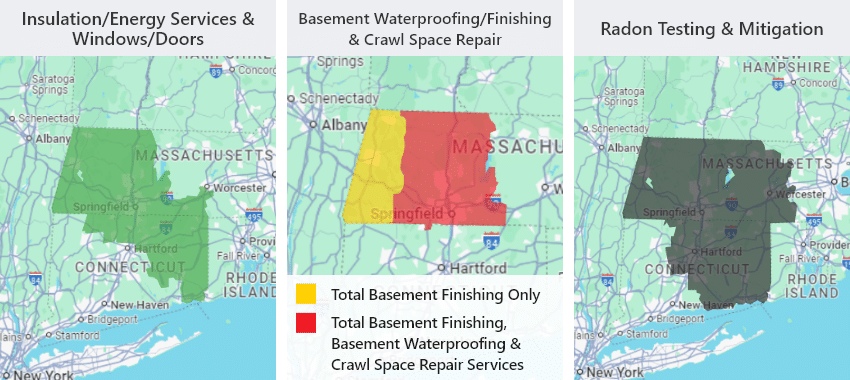
Proudly Serving Western Massachusetts, Northern Connecticut, and surrounding areas.
Fogarty's Home Services Before & After Photos
Click on a photo to enlarge.
Super Attic Advanced Conversion System in Southampton, MA


super attic advanced conversion system in Southampton, MA to make the home less drafty, warmer in the winter, and cooler in the summer.
Insulating a Home Open to the Outside in Southampton, MA


This homeowner in Southampton, MA called us due to very cold floors she had every winter. Our Home Comfort Specialist came out to her home, and she noticed that this homeowner's fiberglass insulation was falling off of the subfloor, rendering it useless.
We were able to help this homeowner. We removed the moldy fiberglass insulation. Then, we insulated the rim joist of the home. After that, we insulated along the bottom of the floor joist with SilverGlo™ foam insulation board. This means the homeowner will have warmer floors, lower energy bills, and more comfortable rooms!
Installing a Radon Mitigation Fan in Westhampton, MA


This homeowner in Westhampton, MA called us hoping that we would be able to help her with her radon mitigation system. She wanted to sell her house, however, the radon system they already had installed was non-functioning. She stated that at one point, the system became quite noisy, so she shut it off. When she went to turn it back on, it would not start.
We were able to help this customer. We replaced her old, non-functioning radon fan with a new one. We utilize many different radon fans depending on many different factors. This home required our Festa AMG Maverick fan. Now, this homeowner has a functioning radon mitigation fan, and she will feel confident listing her home on the market!
Reduced Cold Floors in East Granby, CT


The homeowner called Fogarty's Home Services concerned about the floors above the basement door being cold. We found that the existing door was old and drafty. We replaced the basement door with a steel-insulated basement door. Now the floors are warmer and the basement is more comfortable.
Updating Insulation and Eliminating Rodent Problem in East Granby, CT


our service area
We serve the following areas
- Adams
- Ashley Falls
- Becket
- Berkshire
- Blandford
- Cheshire
- Chester
- Cummington
- Dalton
- Drury
- East Otis
- Glendale
- Granville
- Great Barrington
- Hinsdale
- Housatonic
- Lanesborough
- Lee
- Lenox
- Lenox Dale
- Middlefield
- Mill River
- Monroe Bridge
- Monterey
- North Adams
- North Egremont
- Otis
- Pittsfield
- Plainfield
- Richmond
- Rowe
- Sandisfield
- Savoy
- Sheffield
- South Egremont
- South Lee
- Southfield
- Stockbridge
- Tyringham
- West Stockbridge
- Williamstown
- Windsor
- Worthington
- Barkhamsted
- Burlington
- Colebrook
- North Canton
- Riverton
- West Hartland
- Winsted