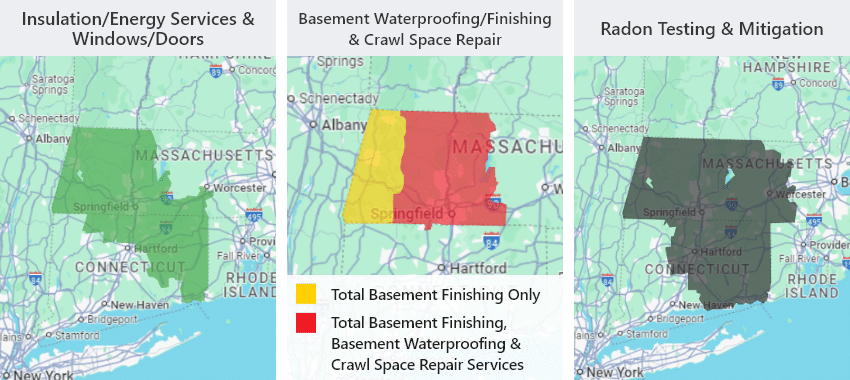
Proudly Serving Western Massachusetts, Northern Connecticut, and surrounding areas.
Fogarty's Home Services Before & After Photos
Click on a photo to enlarge.
Insulating an Attic in Stonington, CT


This homeowner in Stonington, CT called us with concerns about his attic insulation. He believed the insulation in his home was water damaged. When our Home Comfort Specialist arrived, he noted that the attic insulation was blown-in fiberglass. The home was almost 50 years old, and was not sealed and insulated to modern standards.
Fogarty's Home Services was able to help this customer create a more comfortable and safe home. We removed the blown-in fiberglass using a large vacuum, ensuring that we got into every tight corner so we could remove all of it. We then got to work air-sealing the attic using our ZypFoam one-part spray foam. We installed baffles in the rafter bays, and marked each electrical component in the attic with flags for the convenience of the homeowners. We then insulated the home using our TruSoft™ blown in cellulose insulation. TruSoft™ insulation is made of 85% recycled material, and it fills all of the gaps and odd shaped voids that you may have in your attic. This home will now be comfortable for years to come!
Making a Home More Comfortable in Thompson, CT


This homeowner in Thompson, CT called us to their home to help with cold floors and humidity. This home had a nasty, dirt crawlspace that was impacting those concerns!
First, we remove all of the old, nasty insulation any debris in the crawlspace. Next, we install our dimpled plastic drainage matting across the floor to create an airspace and thermal break. TerraBlock™ floor insulation is installed over the dimpled drainage mat. Now, our heavy-duty, 20 mil thick CleanSpace™ crawl space encapsulation liner is installed permanently across the dirt floor. It is sealed with mechanical fasteners to the walls and spiked to the floor. This will drastically reduce the cold floors and keep water and moisture out of the crawlspace, and make this home more comfortable and energy efficient!
Installing a Radon Mitigation System in Thompson, CT


This homeowner in Thompson, CT called us hoping that we would be able to help her with the home she was closing on. During the homebuying process, they found that their radon level fell between 8 and 10 pCi/L on average. This is higher than the EPA's radon action level of 4 pCi/L. She was very uncomfortable about how high the radon level was. She wanted a mitigation system installed immediately -- ideally before they moved into the home.
We had the perfect solution for this customer! We installed a radon mitigation system in his home. We identified the specific space where the mitigation system should be installed. After that, we drilled a hole in the floor as well as a hole in the wall for the exterior penetration. We put together the pipes, starting in the floor, and built it out through the exterior penetration to the outside. We secured the pipes to the wall, and then installed the manometer onto the pipe. (A manometer measures the pressure of the radon gas in the system, indicating whether or not the system is functioning). We then went outside to continue building out the system. We installed the fan and continued building out the pipes, securing them to the outside of the home. Our technician then sealed around the holes that had been drilled for the system. Now, the homeowner has a brand new radon system for their new home!
Sealing Cracks in a Basement in Thompson, CT


This homeowner in Thompson, CT called us hoping to install a radon mitigation system in her home. Her radon levels were, on average, 8-10 pCi/L. This is much higher than the EPA's radon action level of 4 pCi/L. This was also a new home, that she had just purchased -- and she wanted to ensure that this was taken care of as soon as possible. When our certified radon measurement specialist came out to evaluate the home, he noted that there were several cracks in the floor. Cracks in a basement need to be sealed if you want to mitigate radon exposure. That is because radon can come through the cracks and into the home, circumventing the radon mitigation system.
We were able to help this customer. In addition to the fan replacement, we sealed the cracks in her basement floor. We lined the cracks on either side with painters tape. We then ensured the area was clean. After that, we went in to fill and seal the cracks using caulk. This prevents radon from entering the basement through them -- making sure that it is vented out using the mitigation system. This homeowner's mitigation system can now keep their radon levels as low as possible!
Replacing a Radon Fan in Thompson, CT


This homeowner in Thompson, CT called us looking for radon fan replacement. It was no longer functioning, and he wanted it fixed as soon as possible. Our radon specialist came out to the home to identify what was going on with his fan, and what he would need. His fan was unable to be fixed, and it needed to be replaced.
We were able to help this customer! We replaced his old, broken fan with a brand new one. We utilize many different radon fans, depending on the specifics of the home. After identifying the perfect fan, we removed the old one. We then installed the new one in its place. We also replaced the manometer on the inside of the home and labeled the radon pipe appropriately. We finally tested the system to ensure it was functioning. Now, the homeowner is very happy!
our service area
We serve the following areas
- Adams
- Ashley Falls
- Becket
- Berkshire
- Blandford
- Cheshire
- Chester
- Cummington
- Dalton
- Drury
- East Otis
- Glendale
- Granville
- Great Barrington
- Hinsdale
- Housatonic
- Lanesborough
- Lee
- Lenox
- Lenox Dale
- Middlefield
- Mill River
- Monroe Bridge
- Monterey
- North Adams
- North Egremont
- Otis
- Pittsfield
- Plainfield
- Richmond
- Rowe
- Sandisfield
- Savoy
- Sheffield
- South Egremont
- South Lee
- Southfield
- Stockbridge
- Tyringham
- West Stockbridge
- Williamstown
- Windsor
- Worthington
- Barkhamsted
- Burlington
- Colebrook
- North Canton
- Riverton
- West Hartland
- Winsted