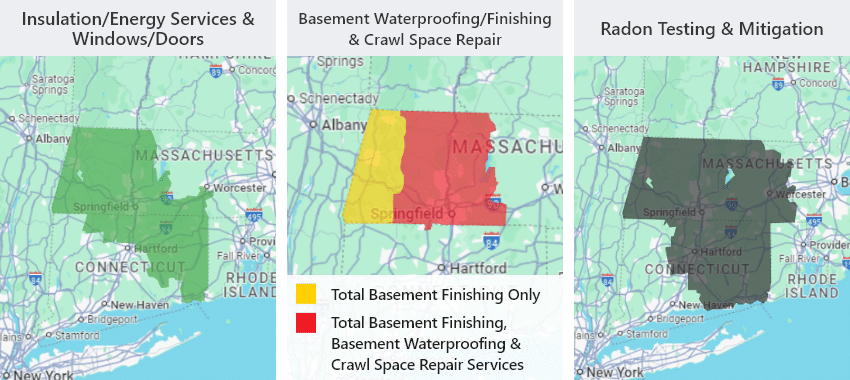
Proudly Serving Western Massachusetts, Northern Connecticut, and surrounding areas.
Fogarty's Home Services Before & After Photos
Click on a photo to enlarge.
Insulating an Attic in New London, CT


This homeowner in New London, CT reached out to us about his vacation home. He wanted to insulate the home, since it was uncomfortable. It also had energy efficiency issues. When our Home Comfort Specialist came out to the home, he noted that they had inefficient fiberglass batts in the attic.
We had the perfect solution for this customer. We were able to replace the attic insulation with TruSoft™ cellulose insulation. We started by removing the fiberglass batts, putting them into bags and bringing them out of the house. We then went in and air-sealed around all of the points where air leaks up from the home to the attic. We did this using our Zypfoam™ spray foam. Once the attic was air sealed, we used a long hose to blow in TruSoft™ cellulose insulation. TruSoft™ is amazing -- it does not burn, get moldy, or attract pests. The blown-in insulation fills all gaps and oddly shaped voids. The homeowner is now much more comfortable!
Insulating an Attic in Baltic, CT


This homeowner in Baltic, CT called us hoping that we would be able to help her with her extreme mold problem in her attic. Our Home Comfort Specialist came out to the home and noted that there was a large amount of insulation, but that it was ineffective. They had had someone come and put fiberglass insulation in over their existing blown-in insulation due to the issues that they were experiencing.
We were able to help this homeowner. We had several solutions that we helped her with. One specific one was re-insulating the attic. We first removed all of the existing insulation -- both fiberglass batts and blown-in insulation.
After that, we went in and air sealed using our Zypfoam™ one-part spray foam. We made sure that all cracks and gaps were sealed, and electrical components were covered with TiteShell™ covers and sealed as well.
Finally, we went in and blew in TruSoft™ cellulose insulation using a long hose. TruSoft™ fills all gaps and odd-shaped voids, meaning that there is a consistent blanket of insulation. This means that the homeowner will have a comfortable home for years to come!
Installing a Radon Mitigation System in Baltic, CT


This homeowner in Baltic, CT reched out to us looking for help with her home. She had a different air system installed by the previous owner, and while she initially believed it was built for radon mitigation, a contractor had told her that it was not. She wanted to add a mitigation system to lower her family's exposure.
We were able to help this customer by installing a radon mitigation system. We began by drilling the holes in the basement -- both in the concrete slab in the bottom and the hole for the exterior penetration. He then began installing the pipes and secured them inside the basement. He installed the manometer on the pipe on the inside of the home. The manometer measures the pressure of the radon in the system, indicating whether or not it is functioning correctly. After that, he went outside to build the rest of the system. He installed the fan on the outside of the home. Once the system was installed, he went back inside, sealing around all of the cracks and gaps in the basement. He also sealed all of the holes that had been drilled for the system. Now, this homeowner has a system designed to keep the radon levels in her home low!
Basement Insulation & Install in Southbridge, MA


Removal of moldy and damaged insulation from crawl space ceiling. Making basement warmer with foamax™ Insulation Board.
Insulating an Attic in Southbridge, MA


This homeowner in Southbridge, MA called us hoping that he could get the insulation in his attic replaced. Unfortunately, it had mold, and needed to be replaced as soon as possible. We first removed the attic insulation, leaving the attic bare (as seen in this photo). After remediating the mold (another solution!), we were able to get started on re-insulating this attic.
We first went in with our ZypFoam™ one-part spray foam. This was used to seal all cracks and gaps in the attic floor - any place where the air from the home would leak into the attic and get lost. After air sealing, we then took to insulating the main part of the attic with our TruSoft™ cellulose insulation. TruSoft™ is blown-in insulation -- meaning that it is literally blown into the attic using a large hose. We installed this insulation to the optimum R-value of R-60. Since it is blown in insulation, it avoids thermal bridging by covering framing members and fills all cracks, gaps, and odd shaped voids. Now, this homeowner's house is more comfortable than ever!
our service area
We serve the following areas
- Adams
- Ashley Falls
- Becket
- Berkshire
- Blandford
- Cheshire
- Chester
- Cummington
- Dalton
- Drury
- East Otis
- Glendale
- Granville
- Great Barrington
- Hinsdale
- Housatonic
- Lanesborough
- Lee
- Lenox
- Lenox Dale
- Middlefield
- Mill River
- Monroe Bridge
- Monterey
- North Adams
- North Egremont
- Otis
- Pittsfield
- Plainfield
- Richmond
- Rowe
- Sandisfield
- Savoy
- Sheffield
- South Egremont
- South Lee
- Southfield
- Stockbridge
- Tyringham
- West Stockbridge
- Williamstown
- Windsor
- Worthington
- Barkhamsted
- Burlington
- Colebrook
- North Canton
- Riverton
- West Hartland
- Winsted