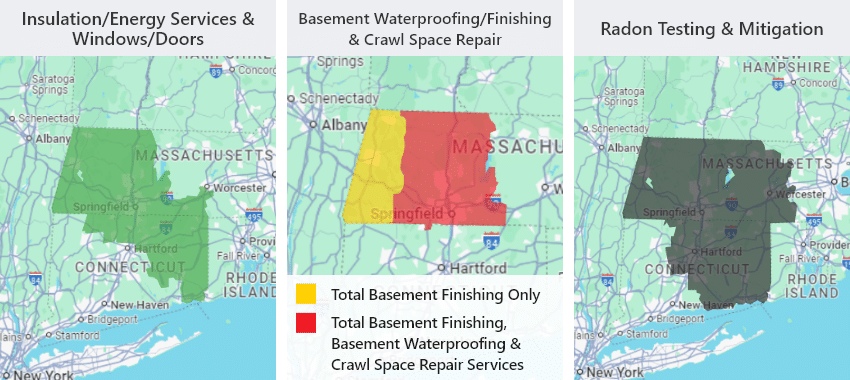
Proudly Serving Western Massachusetts, Northern Connecticut, and surrounding areas.
Duct Encapsulation in Manchester, CT
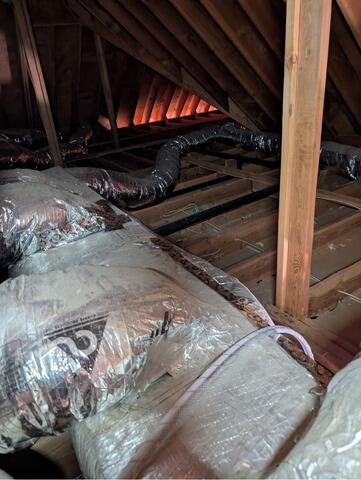
This homeowner in Manchester, CT reached out to us wanting to talk to us about insulation. He believed that he needed insulation in his walls. When our Home Comfort Specialist came out to the home, he noted a few issues with their insulation. In particular, it was noted that they had little insulation in their attic. Additionally, they had unencapsulated HVAC ducts. A vented attic is the worst possible place to locate ducts. Attics are the extreme opposite temperature of the air the ducts are trying to distribute to rooms in the home. They are 30˚F in winter when the air in the duct is 120˚F, and 125˚F in summer, when the air inside the duct is 55˚F. Ducts are very poorly insulated with fiberglass insulation - and air passes right through fiberglass. In winter the attic cools the duct and air in it. So instead of having 120˚F air that the homeowner paid to heat coming out of the registers into their rooms, it may be only 90˚F - making the residents uncomfortable, and the furnace run longer to heat the home - which costs them money. In the summer, the 120˚F + attic heats their ducts and air in them, and instead of 55˚F air that they paid to cool coming into their rooms, it may be 70˚ - reheated by the ducts in their hot attic. Their AC has to run longer to make them comfortable. Ducts have lots of joints, gaps and holes. These are not only air leaks into the vented attic when the air handler is OFF, but they are POWERED air leaks when it’s on. Air the homeowner paid to heat and cool and want to go to their rooms is leaking out of the ducts into their attic and is lost! Return duct leaks suck in very cold dusty air to try to heat, or very hot dusty air to try to cool. Result - Uncomfortable rooms, some rooms (farther from the air handler) won’t heat/cool, higher fuel and electric bills, more dust, more noise.
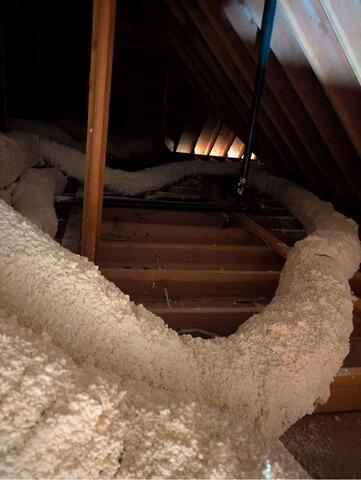
We had the perfect solution for this customer! In this solution, we seal and insulate ducts right over the existing insulation with 1” of closed cell foam insulation. Air cannot leak through the foam. Not only does Tite ‘n’ True Foam Duct Encapsulation have a superior R-value per inch, but it recovers some insulation value from their existing duct wrap by making it air tight. Any inaccessible areas on the bottom of ducts can’t be sprayed with foam, but when this solution is combined with TruSoft™ blown insulation, the ducts are often substantially buried in cellulose insulation as well. Now, when the furnace or air conditioner heats or cools the air, that heating/cooling is delivered to their rooms without loss along the way! Results - More comfortable rooms, warmer in winter and cooler in summer, less dust/noise, lower fuel/electric bills, longer furnace/AC equipment life.
our service area
We serve the following areas
- Adams
- Ashley Falls
- Becket
- Berkshire
- Blandford
- Cheshire
- Chester
- Cummington
- Dalton
- Drury
- East Otis
- Glendale
- Granville
- Great Barrington
- Hinsdale
- Housatonic
- Lanesborough
- Lee
- Lenox
- Lenox Dale
- Middlefield
- Mill River
- Monroe Bridge
- Monterey
- North Adams
- North Egremont
- Otis
- Pittsfield
- Plainfield
- Richmond
- Rowe
- Sandisfield
- Savoy
- Sheffield
- South Egremont
- South Lee
- Southfield
- Stockbridge
- Tyringham
- West Stockbridge
- Williamstown
- Windsor
- Worthington
- Barkhamsted
- Burlington
- Colebrook
- North Canton
- Riverton
- West Hartland
- Winsted