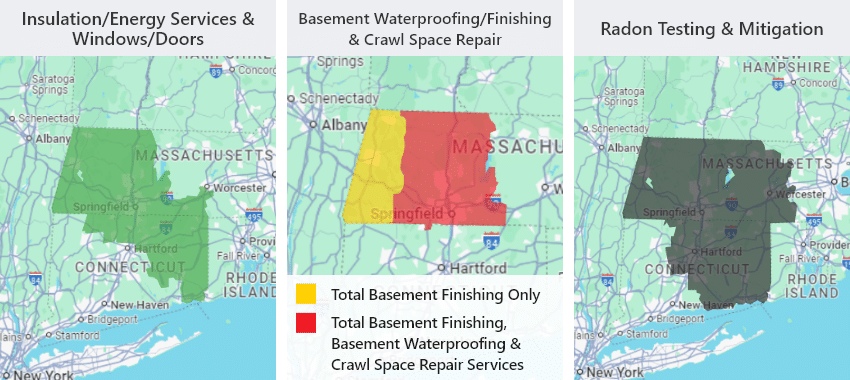
Proudly Serving Western Massachusetts, Northern Connecticut, and surrounding areas.
Insulating an Attic in West Springfield, MA


This homeowner in West Springfield, MA called us hoping that we would be able to help with his attic insulation. He believed he did not have enough insulation, and had had rodent issues that meant that he wanted his insulation removed and replaced. Since attics are vented, we should think of them thermally as outside in the winter. In summer because of the suns radiant heat, they are much worse than outside, reaching 130˚ on summer days. Clearly, we need to keep an absolute boundary between our living space and the attic so inside air doesn’t move to the attic in the heating season (convection), and heat doesn’t pass up through our ceilings in winter (conduction), and down from our ceilings in the hot summer (conduction, radiation). To reduce overall air leakage, the attic is the first priority because warm air rises to the top of the house and finds any and all holes to leak out into the cold vented attic and is lost. Holes, gaps and joints include between drywall and framing at the top of walls, around pipes, wires, electric boxes, fixtures, duct, penetrations, ceiling grilles and joints in framing. And the only reason cold air leaks in from the outside at the lower levels of the house, is that warm air leaked out of the top and created a suction at the bottom.
We had the perfect solution for this customer. Adding insulation in an attic without sealing all air leaks first should never be done, because it is just burying air leaks and making them impossible to seal later - and insulation DOES NOT STOP air leaks. That’s why, in this solution, we first carefully air seal the many various points where air from the home leaks up into the attic and is lost. Our premium TruSoft™ cellulose insulation is blown to the optimum R-value (typically R60). TruSoft™ will not burn, get moldy, or attract pests. Blown insulation fills all gaps and odd shaped voids, and by filling over framing members, “thermal bridging” is avoided.
our service area
We serve the following areas
- Adams
- Ashley Falls
- Becket
- Berkshire
- Blandford
- Cheshire
- Chester
- Cummington
- Dalton
- Drury
- East Otis
- Glendale
- Granville
- Great Barrington
- Hinsdale
- Housatonic
- Lanesborough
- Lee
- Lenox
- Lenox Dale
- Middlefield
- Mill River
- Monroe Bridge
- Monterey
- North Adams
- North Egremont
- Otis
- Pittsfield
- Plainfield
- Richmond
- Rowe
- Sandisfield
- Savoy
- Sheffield
- South Egremont
- South Lee
- Southfield
- Stockbridge
- Tyringham
- West Stockbridge
- Williamstown
- Windsor
- Worthington
- Barkhamsted
- Burlington
- Colebrook
- North Canton
- Riverton
- West Hartland
- Winsted