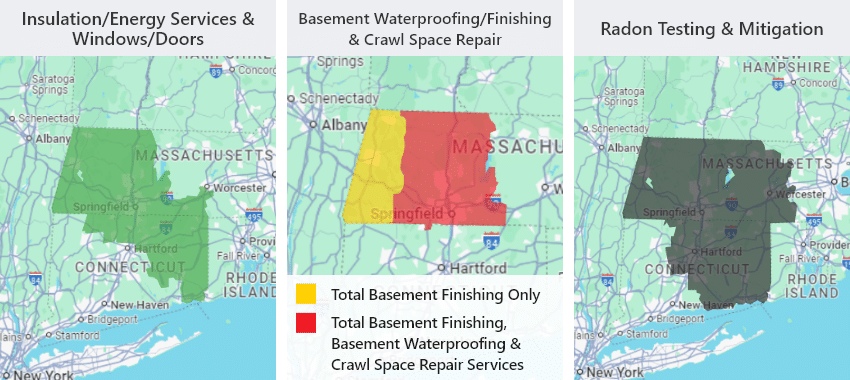
Proudly Serving Western Massachusetts, Northern Connecticut, and surrounding areas.
Fogarty's Home Services Before & After Photos
Click on a photo to enlarge.
Fix Leaky, Uninsulated Attic Hatch Pull Down Stairs in Manchester, CT


Fogarty's Home Services received a call from the homeowner who was experiencing cold, drafty rooms near the attic hatch pull down stairs to his attic. Attic hatch pull down stairs are necessary to access your attic. The problem is that when closed, they leak a LOT of air that you paid to heat from your home to the vented attic where it is lost. All of this warm air leaving the top of the house is replaced with cold outside air entering at the lower levels of your home, causing drafts, cold floors and uncomfortable rooms that are hard to heat.
Fogarty's Home Services installed an exclusive "David Lewis Hatch Cover" (named for our engineer who developed it) that rests right over your pull down stairs. It stops air leakage and insulates over the stairs. Made of lightweight SilverGlo™ foam insulation, you just lift it aside to go up to your attic, and set it back in place when you leave. You don't see anything from the finished area of your home. SilverGlo™ foam insulation has graphite infused into the foam which bumps up the insulation value by 24% over standard EPS foam. It also has a radiant barrier (foil) on the flat lid to reflect heat back in during winter and out in the summer, so the insulation isn't doing all the work by itself. Now the homeowner has a tighter, more comfortable, less drafty home he'll notice. His rooms are easier to heat and he'll experience lower fuel and electric bills.
Insulating a Basement in Coventry, CT


This customer in Coventry, CT called us with concerns he had about his basement insulation. When our Home Comfort Specialist arrived at the home, he identified several areas of concern. The largest was the insufficient insulation this homeowner had in his basement's rim joist. Not all of the rim joist was insulated, and when it was, it was with fiberglass -- notoriously insufficient insulation. The batts were falling apart and falling down, and they had rodents and other critters living in them. This customer also had issues with an uninsulated window that he had put a piece of plywood over. This did nothing to stop the outside air from coming through.
We took the old fiberglass insulation down. In its place, we installed two-part expanding spray foam insulation into the rim joist. This insulation expands to seal all the cracks, gaps, and joints in the rim joist. It has a high insulation value as well -- making sure that the basement kept the conditioned air inside.
Now, this basement will be comfortable for years to come!
Insulweb Installation in Rocky Hill, CT


This customer purchased a home built in 1860. They gutted the entire home to do major renovations. Our team came in to ensure the home was properly insulated. Once the walls were down to the studs, we put up Insulweb and dense packed every wall with cellulose to make the home more comfortable and energy efficient.
Properly Venting a Bathroom Fan in Salem, CT


This bathroom fan was being vented directly into the attic. All the warm humid air from the bathroom was going into the attic which can cause mold. Our team went in and properly vented the moisture outside through the roof using our insulated duct work. This homeowner no longer has to worry about mold issues in the attic.
Air Sealing Top Plates in Watertown, CT


This homeowner contacted us because she wanted to save on her heating costs. Air sealing top plates is important in stopping conditioned air from leaking into the unconditioned attic space. Top plates are at the top of every wall in every home. During construction, there is a quarter inch gap left. This gap allows warm air to escape in the winter and cool air to escape in the summer. Our team air sealed all the top plates in this attic. This homeowner will save on her heating costs and her home will be more comfortable year round.
our service area
We serve the following areas
- Adams
- Ashley Falls
- Becket
- Berkshire
- Blandford
- Cheshire
- Chester
- Cummington
- Dalton
- Drury
- East Otis
- Glendale
- Granville
- Great Barrington
- Hinsdale
- Housatonic
- Lanesborough
- Lee
- Lenox
- Lenox Dale
- Middlefield
- Mill River
- Monroe Bridge
- Monterey
- North Adams
- North Egremont
- Otis
- Pittsfield
- Plainfield
- Richmond
- Rowe
- Sandisfield
- Savoy
- Sheffield
- South Egremont
- South Lee
- Southfield
- Stockbridge
- Tyringham
- West Stockbridge
- Williamstown
- Windsor
- Worthington
- Barkhamsted
- Burlington
- Colebrook
- North Canton
- Riverton
- West Hartland
- Winsted