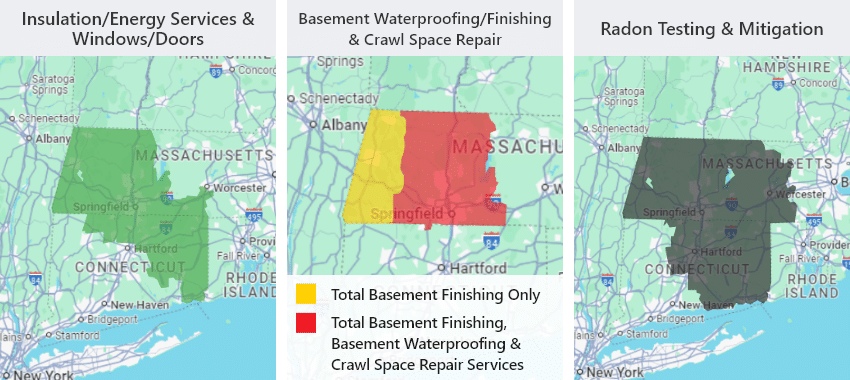
Proudly Serving Western Massachusetts, Northern Connecticut, and surrounding areas.
Fogarty's Home Services Before & After Photos
Click on a photo to enlarge.
Helping a Home Stay Comfortable in Colchester, CT


This homeowner in Colchester, CT was having trouble keeping their home comfortable. They had their HVAC system running through their attic. Given the extreme temperatures in attics, the system has to work double time to keep the air running through the ducts cool in the summer and warm in the winter.
To help keep the ducts safe from those extremes, we used our Tight N' True duct encapsulation system. The spray foam air seals as it insulates to make sure no energy is lost. Once done and cured, we are able to blow our TruSoft cellulose into the attic, right up against those ducts.
Thanks to Dr. Energy Saver by Eco Energy Solutions, this home will stay comfortable and save money doing so!
Insulating an Attic in Colchester, CT


This homeowner in Colchester, CT called us hoping she would be able to talk to us about her home. She wanted to have an energy evaluation done on her entire home, as she had high energy bills. She also had a very cold house in the winter, and a very warm house in the summer -- she wanted to ensure that the air that she paid to heat in winter and cool in summer would stay inside her house. Due to her inefficient fiberglass insulation, outside air was traveling into the attic and down to the main home, and the air she paid to heat that winter was traveling up into the attic and outside, where it is lost. Her home did not have the proper air sealing and insulation needed to prevent this issue.
We had the perfect solution for this customer. We were able to insulate her home using our TruSoft™ cellulose insulation. First, though, we had to air seal all of the points where air leaked up into the home. We sealed the cracks, gaps, and other spots in the attic. We then utilized our blown-in cellulose insulation. It is blown in using a large hose, filling all odd shaped voids and covering framing members. We insulated this attic to the necessary R-value of R60. Now, this homeowner will be much more comfortable for years to come!
Cleaning Up a Crawlspace in Ware, MA


This homeowner in Ware, MA came to us with very high energy costs, going through an unbelievable amount of oil a month.
We seal along the walls and insulate with our SilverGlo foam to keep cold air from getting in. We put down matting to allow for some air flow followed by TerraBlock insulation and a vapor barrier to keep moisture and cold air from coming up through the dirt.
Heating this home will now be far cheaper thanks to Dr. Energy Saver by Eco Energy Solutions.
Knee Wall Insulation


The floor upper level, the ceiling of the lower level and knee-wall are all cold in winter and hot from radiant roof heat in the summer. This result makes the knee-wall space not suitable for storage since it is dusty and very cold or hot. To resolve this Fogarty Home Services uses blocks of SilverGlo™ foam Insulation that is installed between ceiling joist bays. Outside the blocks, the surface of the sealing is sealed with sprayed foam or SilverGlo™ foam.
Crawl Space Sump Pump install in Columbia, CT


Crawl space sump pump installation.
our service area
We serve the following areas
- Adams
- Ashley Falls
- Becket
- Berkshire
- Blandford
- Cheshire
- Chester
- Cummington
- Dalton
- Drury
- East Otis
- Glendale
- Granville
- Great Barrington
- Hinsdale
- Housatonic
- Lanesborough
- Lee
- Lenox
- Lenox Dale
- Middlefield
- Mill River
- Monroe Bridge
- Monterey
- North Adams
- North Egremont
- Otis
- Pittsfield
- Plainfield
- Richmond
- Rowe
- Sandisfield
- Savoy
- Sheffield
- South Egremont
- South Lee
- Southfield
- Stockbridge
- Tyringham
- West Stockbridge
- Williamstown
- Windsor
- Worthington
- Barkhamsted
- Burlington
- Colebrook
- North Canton
- Riverton
- West Hartland
- Winsted