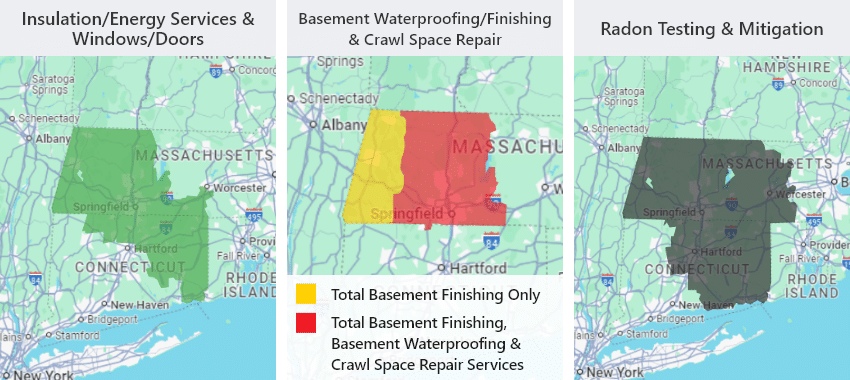
Proudly Serving Western Massachusetts, Northern Connecticut, and surrounding areas.
Fogarty's Home Services Before & After Photos
Click on a photo to enlarge.
Insulating a Basement in Marlborough, CT


This homeowner in Marlborough, CT called us hoping that we would be able to help her with her basement. She had issues with her home, specifically, she had musty smells and cold floors.
This basement had no insulation. Therefore, the customer was hoping for insulation in the rim joist. The rim joist is the perimeter of the floor framing system along the exterior of the house.
Luckily, we had the perfect solution for this customer. We insulated the basement with two-part closed cell spray foam. This spray foam expands and fills all cracks and gaps in the rim joist and over the sill plate. Now, this home will be much more comfortable, and there are no more air leaks in the basement!
Adding a Radon Fan to a Home in Marlborough, CT


This homeowner in Marlborough, CT called us hoping that we would be able to help him with his home. His home's radon level had recently tested to be 7 pCi/L -- higher than the EPA's radon action level of 4 pCi/L. He wanted to have an evaluation in order to talk about mitigation solutions. He disclosed that the house had just been built, and it already had a radon pipe, just no fan. Our radon specialist came out in order to evaluate what solutions they would need.
We were able to help this customer. The existing radon system was completely internal -- it was routed up into the attic and out through the roof. We were able to help by adding a radon mitigation fan. This was added to the pipes in the attic. We also replaced the manometer in the basement with a brand new one. (The manometer measures the pressure of the radon gas in the pipe). We tested the system and were done. Now, this homeowner has a functioning radon mitigation system!
Duct Encapsulation in Attic in Bolton, CT


These homeowners in Bolton, CT were having a difficult time keeping their home comfortable. They have their heating and cooling system running through the attic, which, being an unconditioned space, is prone to extreme temperatures. Given those extremes, the system has to work harder to keep the air running through the ducts at the desired temperature despite the air around it.
We used our Tight n' True Duct encapsulation system to insulate the ducts. We started with our SilverGlo insulation board on the top side of the ducts. SilverGlo is a graphite infused EPS foam board with a radiant barrier, doing double the work to stop the transfer of heat. We then spray 1 inch of closed cell spray foam insulation on the sides of the ducts. The bottom of the ducts can't be sprayed, however, once we blow our TruSoft cellulose in the attic, covering much of the duct, the space will be buried.
Thanks to Dr. Energy Saver by Eco Energy Solutions, the heating system doesn't have to work nearly as hard to keep the home comfortable, lowering energy costs.
Making Cold Floors Warmer in Hampden, MA


This homeowner in Hampden, MA called us out to their home for a Free Home Energy Evaluation to see how we could make their home more energy-efficient. They were having concerns with cold floors and drafty rooms. One thing we noticed was that the basement door to exit the home was very old, uninsulated, and inefficient. The hatch doors that cover them are completely uninsulated as well. This allows massive amounts of air to leak in and out of the home creating cold floors and drafts.
We removed the old, inefficient door. Next, we install a new insulated basement door with proper framing and weatherstripping. Now, this will stop air from leaking into or out of the home in this area.
Thanks to Dr. Energy Saver by Eco Energy solutions this home is one step closer to optimum energy efficiency.
Encapsulating a Crawlspace in Hampden, MA


This homeowner in Hampden, MA called us hoping to find a solution for her mold problem. When our Home Comfort Specialist arrived, he noted that the dirt crawl space was uninsulated and unencapsulated. This was fairly common for the time the home was built. However, building science has changed a lot in the intervening 80 years.
We were able to help this homeowner by utilizing our CleanSpace™ encapsulation system. The CleanSpace™ encapsulation system features dimpled plastic drainage matting, TerraBlock™ floor insulation, and SilverGlo™ insulation on the walls. It is then finished off with a CleanSpace™ crawlspace liner. This ensures an insulated, clean crawlspace that keeps the entire home more comfortable and less prone to mold and moisture.
our service area
We serve the following areas
- Adams
- Ashley Falls
- Becket
- Berkshire
- Blandford
- Cheshire
- Chester
- Cummington
- Dalton
- Drury
- East Otis
- Glendale
- Granville
- Great Barrington
- Hinsdale
- Housatonic
- Lanesborough
- Lee
- Lenox
- Lenox Dale
- Middlefield
- Mill River
- Monroe Bridge
- Monterey
- North Adams
- North Egremont
- Otis
- Pittsfield
- Plainfield
- Richmond
- Rowe
- Sandisfield
- Savoy
- Sheffield
- South Egremont
- South Lee
- Southfield
- Stockbridge
- Tyringham
- West Stockbridge
- Williamstown
- Windsor
- Worthington
- Barkhamsted
- Burlington
- Colebrook
- North Canton
- Riverton
- West Hartland
- Winsted