Proudly Serving Western Massachusetts, Northern Connecticut, and surrounding areas.

Insulation Services
Spray Foam Insulation
Crawl Space Insulation
Attic Insulation
Blown-in Insulation
Radient Barrier
Cellulose Insulation
Rigid Foam Insulation
Garage Insulation
Ductwork Sealing
Ice Damming
Radon Mitigation
Radon Testing
Radon Mitigation Systems
Radon Fan Replacement
Indoor Air Quality Solutions
Breathe EZ UVC Light
Breathe EZ Air Cleaner
Energy Recovery Ventilator
Vapor Intrusion Mitigation
| Before | After |
|---|---|
|
|
The owner of a beautiful brick home in West Springfield, MA contacted Fogarty's Home Services to help insulate his home. He was experiencing cold drafts and wanted to resolve this issue. One of our Home Comfort Specialists discovered that there were sloped stairwell ceilings that were open to the attic when conducting this homeowner's free home energy evaluation. When a stairwell has a sloped ceiling forming a big triangular space that is open to the attic, it creates a heat loss (winter) and heat gain (summer) problem in the home. The sidewalls of the open well into the attic are hard to insulate and often leak air from the walls of your house into the attic. The stairwell ceiling radiates heat from the house in to the attic, and from the hot attic to the house in the summer. Insulating the attic properly is not possible with this big stairwell hole in it. Fogarty's Home Services installed a cover made of wood over this stairwell at the attic floor level. Appropriate framing and wood sheets were used. The cover was sealed with expanding polyurethane foam to make it airtight. Blown insulation can now be installed over the attic floor and the stairwell cover. The sturdy cover doesn't pose a fall hazard if someone crawls into the attic in the future. Now, this happy customer is reporting less air leakage, less unwanted heat loss and heat gain, and the attic can be insulated properly.
| Before | After |
|---|---|
|
|
This homeowner's basement windows were old, leaky, and inefficient. In the past, home builders paid little attention to the energy efficiency of basement windows, often choosing the cheapest option available. This leaves single pane glass windows with metal frames that let lots of cold air leak into the home. Single pane clear glass lets heat from the home escape by conduction through the cold glass. Metal is highly thermally conductive and a poor material for a window frame - it rusts in the damp environment near the ground and leaks a LOT of air. Fogarty's Home Services removed the old windows and frames and installed New Everlast™ basement windows. These sliding windows have double pane glass with a specially metallic "Low E" coating on the inside of both panes of glass to reduce heat flow in or out through the glass. The frame and sashes are made completely from vinyl - the perfect material for a window so close to the ground in a damp environment - they will never rust, rot, or need paint. And Everlast™ windows are a big improvement over the way your home looks - great! This happy customer now has a warmer basement, warmer floors above the basement, less drafts, less condensation, lower overall home air leakage, and lower energy bills.
| Before | After |
|---|---|
|
|
The second floor of a Cape suffers from inadequate insulation, and air leaks from the soffits into poorly insulated kneewall spaces. This results in cold drafty rooms in winter that are harder than necessary to heat, and hot rooms in the summer as roof heat radiates in unchecked. Kneewall spaces are dusty and too cold or hot which is unsuitable for clean storage.
First, our SilverGlo™ foam insulation panels are installed on the bottom of the rafters in the kneewall spaces and the ceiling joist bays are blocked and sealed with foam to stop air leakage. Then the roof slopes are dense packed with TruSoft™ cellulose insulation to stop air flow and insulate. Finally, the flat ceiling is insulated with TruSoft™ cellulose insulation.
Click the icons to see what our customers had to say.
Improve home comfort and lower energy bills with the quality spray foam insulation from Fogarty's Home Services! We often recommend spray foam because it effectively fills gaps and cracks, providing an air-tight barrier. The super-adhesive qualities also make it great to use in hard-to-reach areas. Plus, since it is waterproof, moisture cannot pass through the foam, unlike fiberglass and cellulose insulation, which makes it extremely durable and long-lasting. To ensure your home has the best insulation available and your energy bills are low, switch to spray foam insulation today!
Lower your energy bills and overall carbon footprint with the attic insulation from Fogarty's Home Services ! Our proven products ensure homeowners a return on their investment and have guaranteed year-round comfort.
Services We Offer:
|
|
See how our solutions can lower your energy costs by 30% or more and contact us for a FREE home insulation estimate. We would love to provide attic insulation to make your home more comfortable!
Did you know that radon gas is one of the leading causes of cancer in the United States? And since it is odorless, invisible, and tasteless, the only way to detect it is through radon testing. But there is no reason to worry! Fogarty's Home Services can help with our reliable radon testing services in and around West Springfield, MA, using a continuous radon monitor. If needed, we can also design and install a personalized radon mitigation system. Or, if you have an existing mitigation system, we can inspect it for you and offer a radon fan replacement.
Plus, home radon isn't the only pollutant we eliminate. We offer indoor air quality services, including dehumidification systems and much more. Call us today to schedule a radon test or estimate on our indoor air quality services!
This homeowner in West Springfield, MA called us hoping that we would be able to come to his home to evaluate his attic. He believed that he did not have enough attic insulation in his home. Additionally, he had some rodents in the home several months prior, and wanted to ensure that the situation would not reoccur. Since attics are vented, we should think of them thermally as outside in the winter. In summer because of the suns radiant heat, they are much worse than outside, reaching 130˚ on summer days. Clearly, we need to keep an absolute boundary between our living space and the attic so inside air doesn’t move to the attic in the heating season (convection), and heat doesn’t pass up through our ceilings in winter (conduction), and down from our ceilings in the hot summer (conduction, radiation). To reduce overall air leakage, the attic is the first priority because warm air rises to the top of the house and finds any and all holes to leak out into the cold vented attic and is lost. Holes, gaps and joints include between drywall and framing at the top of walls, around pipes, wires, electric boxes, fixtures, duct, penetrations, ceiling grilles and joints in framing. And the only reason cold air leaks in from the outside at the lower levels of the house, is that warm air leaked out of the top and created a suction at the bottom.
We had the perfect solution for this customer. Adding insulation in an attic without sealing all air leaks first should never be done, because it is just burying air leaks and making them impossible to seal later - and insulation DOES NOT STOP air leaks. That’s why, in this solution, we first carefully air seal the many various points where air from the home leaks up into the attic and is lost. Our premium TruSoft™ cellulose insulation is blown to the optimum R-value (typically R60). TruSoft™ will not burn, get moldy, or attract pests. Blown insulation fills all gaps and odd shaped voids, and by filling over framing members, “thermal bridging” is avoided.
This homeowner in West Springfield, MA called us hoping that we would be able to help her. Their sunroom smelled like mold and they were not sure where the smell was coming from. When our Home Comfort Specialist arrived in the home, he was able to inspect and found where the moldy smell was coming from. Mold in an attic is not normal, not healthy, and a sign that there is another problem in the home causing the relative humidity in the attic to go above 75% so mold can grow on wood and insulation. We can surely fix the relative humidity problem with other solutions, but what about the mold that’s already there? Can it be eliminated with an effective treatment? Result - Mold all over the roof deck, odor and even rot.
We had the perfect solution for this customer. We utilized our Mold-X2 Cleaner and Mold-X2 Botanical solutions. Mold-X2 Cleaner effectively eliminates mold and mildew stains on contact. It is non-abrasive and non-flammable, and was sprayed on effected areas. Once Mold-X2 Cleaner is applied, mold disappears instantly, leaving wood surfaces looking nearly new. Mold-X2 Botanical, a plant-based disinfectant with a pleasant, temporary scent, was sprayed on the surface, which prevents mold from growing back. Now the attic is ready for our other solutions. Result - Mold eliminated, no odors or wood rot.
This homeowner in West Springfield, MA called us hoping to get his windows replaced in his home. They were not energy efficient and just needed to be replaced. Usually, home builders paid little attention to the energy efficiency or looks of basement windows, often choosing the cheapest option available. This leaves the home with single pane glass windows with metal frames that let lots of cold air leak into the home. Single pane clear glass lets heat from the home escape by conduction through the cold glass. Metal is highly thermally conductive and a poor material for a window frame. And metal rusts in the damp environment near the ground. Perhaps the worst part is that these basement windows leak air - lots of it, because the house has lower air pressure at the bottom and sucks cold outside air into the home, causing a cold basement and cold floors above. And let’s face it, these windows are ugly. Results - cold basement, cold floors upstairs, drafts, higher fuel and electric bills, more condensation in the basement in the summertime, less comfortable home.
Luckily, Fogarty's Home Services had the perfect solution for this customer. The window sashes were removed and Everlast™ basement window inserts were installed and sealed airtight. They feature 2 panes of high performance “Low E” glass, which let’s visible light through but block most of the heat flow with a special metallic coating on the inside of both panes of glass. The sash features a vinyl frame - the perfect material for a window in the damp environment near the ground. The vinyl looks great and will never rust, rot or need paint. And the new efficient windows will look great! Results - warmer basement, warmer floors above the basement, less drafts, less condensation in summer, lower overall home air leakage, lower fuel and electric bills.
This homeowner in West Springfield, MA called us when water was coming in through his window wells. When our Home Comfort Specialist arrived at the home, he noticed that the current window wells attached to the home had ill-fitting covers. Therefore, water was getting in around them, which was causing the water in his basement. Open metal window wells let leaves and debris collect in them, blocking light to a basement. Rain gets in, and water from over flooding gutters cascades into the window wells. Weeds grow in the window wells since they have no bottom, and mud splashes up against your window glass. And let’s face it - they are ugly! Results - Constant maintenance, far less natural light to the basement, and they are ugly!
Luckily, Fogarty's Home Services had the perfect solution for this customer. We removed their old enclosures and installed SunHouse™ window enclosures. The SunHouse™ window enclosure is a bright color and has a bottom to reflect much more light into the basement. The bottom prevents weeds from growing and mud doesn’t splash against the windows. SunHouses™ have a sturdy matching clear cover to keep rain and leaves out, and it keeps the wind from blowing against the windows. Plus, a window drain system was installed as well -- meaning they are protected against window wells flooding!
Building code requires that no combustible materials, including wood framing and insulation, be within 2” of a masonry chimney. This has left millions of homes with an airspace from the basement or crawl space right to the attic. Air that you paid to heat is continually leaking out of your home to the vented attic where it is lost. Results - a more drafty, uncomfortable house that’s harder to heat, higher fuel and electric bills.
Fogarty's Home Services Solution: Chimney Wrap. First the space between the wood framing and masonry is flashed with metal and then sealed airtight with special high temperature fire caulk. Then completely fireproof “Rock Wool” insulation panels are installed around the chimney so that TruSoft™ cellulose insulation may be blown against the chimney. “Chimney Wrap” leaves no gaps in the insulation around your chimney, and seals one of the biggest air leaks in your home.
Results - Lower house air leakage, less heat loss, home is more comfortable and easier to heat - lower fuel bills.
The second floor of a Cape suffers from inadequate insulation, and air leaks from the soffits into poorly insulated kneewall spaces. This results in cold drafty rooms in winter that are harder than necessary to heat, and hot rooms in the summer as roof heat radiates in unchecked. Kneewall spaces are dusty and too cold or hot - unsuitable for clean storage.
First, our SilverGlo™ foam insulation panels are installed on the bottom of the joists in the kneewall spaces and the ceiling rafter bays are blocked and sealed with foam to stop air leakage. Then the roof slopes are sprayed with closed cell spray foam to stop air flow and insulate. This creates a super insulated kneewall. A thermal or ignition barrier coating is added when kneewalls have HVAC equipment or are used for storage. Finally, the flat ceiling is insulated with TruSoft™ cellulose insulation.
The result, rooms are comfortable all year and need much less heat and air conditioning. Drafts are eliminated as kneewall spaces are airtight and clean and suitable for storage. Summer roof heat is far less.
Steps from your basement to the outdoors are convenient, but the (metal) hatch doors that cover them are completely uninsulated and leak lots of air. Cold winter air gets sucked into your home continually in winter. In summer, warm humid hair enters the basement and causes condensation on cool floors, walls, and ducts. Results - Cold basement, cold floors on the first floor, drafts higher heating/fuel costs, condensation in summer, higher electric costs for A/C. Proper framing is installed and a new insulated exterior door with weather-stripping and locking knob is installed. Now, "inside" the house is inside the door, and "outside" is outside the door, so it doesn't matter that the hatch door is uninsulated and leaks air. Results - Warmer basement and floors over the basement, drier basement in the summer, lower fuel and electric costs, less drafts, house is easier to heat, more security.
Problem:
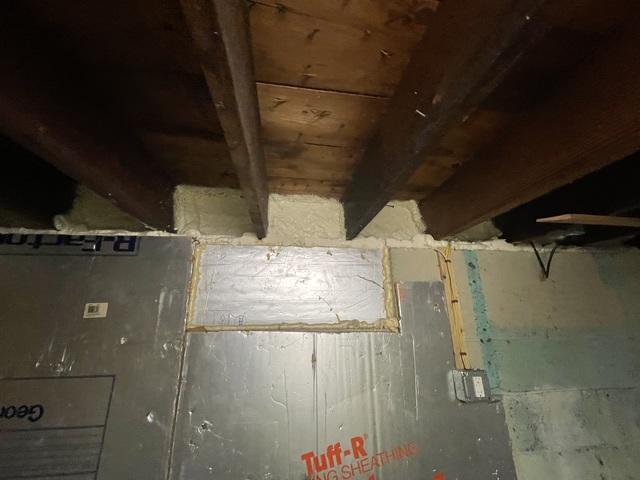
This homeowner contacted us with a problem that floors being cold and drafty. We got over to the house to do our Free evaluation and discovered that air was leaking through the rim joists and the window in the basement.
Solution:
We talked it over with the homeowner and came up with a plan to seal the rim joists with spray foam and to cover up the window with a foamax board, this will prevent any outside air from sneaking through the basement. The homeowner was extremely happy when they saw the finished product and loved how the floors were no longer cold.
Or call us at 1-860-406-5698
1-860-863-0385
Fogarty's Home Services
800 Prospect Hill Rd
Ste E
Windsor, CT 06095
Fogarty's Home Services
258 Old Lyman Rd Suite B
South Hadley, MA 01075
CT HIC # 0645665
MA HIC # 185329
© 2025 Fogarty's Home Services | Privacy Policy | Terms of Use | Sitemap