Proudly Serving Western Massachusetts, Northern Connecticut, and surrounding areas.

Radon Mitigation
Radon Testing
Radon Mitigation Systems
Radon Fan Replacement
Indoor Air Quality Solutions
Breathe EZ UVC Light
Breathe EZ Air Cleaner
Energy Recovery Ventilator
Vapor Intrusion Mitigation
| Before | After |
|---|---|
|
|
This homeowner was referred to us by an existing customer who recently had work done and knew we were perfect for the job. The homeowner had a terrible problem with mold in her attic and asked us to send someone out to help.
Our Building Science Specialist was able to easily identify the problem as being a poorly vented out bath fan leading to the attic. The air coming from the bathroom was mostly warm air, hitting the cold air in the attic and condensing into water and resulting in mold. We completely removed all existing, moldy fiberglass insulation and then cleaned and prepped the area for treatment with our MoldX2™ Cleaner and Botanical. We then built a deck and dam and blew in new TruSoft™ Cellulose insulation. Next we ducted the bath fan out through the gable end and outside, preventing future mold issues. We completed the job by installing a David Lewis™ attic pull-down stair hatch cover to air seal and insulate the entrance to the attic.
| Before | After |
|---|---|
|
|
A customer in Middletown, CT called us in order to ensure that his attic was properly insulated. Our Home Comfort Specialist identified several places in this home that needed sealing and proper insulation. Our team used ZypFoam™ in order to properly seal the attic. We then used loosely blown TruSoft™ cellulose insulation on the attic floor and densely packed it into the exterior walls of the home. This ensures a more comfortable home. This customer will now have reduced energy loss year round!
| Before | After |
|---|---|
|
|
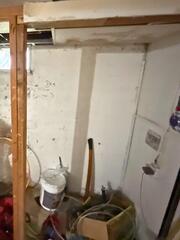
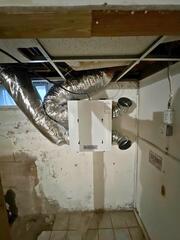
This homeowner in Middletown, CT called us because she was concerned about her radon exposure. She had a young child that lived in the home, and was concerned about the child's exposure to radon. The radon level in her basement had gone up and was now around 2 pCi/L. While this is under the EPA's radon action level of 4 pCi/L, the homeowner stated that they wanted their radon level as low as possible, and they were quite concerned about their exposure. Her family was keeping the windows open in the home to mitigate the exposure. This is despite the fact that it was the middle of winter, with temperatures frequently between 20-30F during the day. They needed a solution.
We were able to help this customer! We installed an energy recovery ventilator (ERV) in their basement. The ERV we installed was the RenewAire EV90, which is 90 CFM. We anchored a mounting plate to the wall. We then mounted the ERV to the wall. We began connecting the ductwork between the ERV and the outside vents. The intake vent is strategically placed to ensure that the air being brought into the home is the best possible quality -- so it is located away from driveways, as well as anything else that might bring in bad air such as HVAC vents or dryer vents. ERV intake vents are placed at least 10 feet apart from any exhaust vents. We also installed ductwork that brings the old air into the system and pushes the fresh air out of the system. The ERV works by removing stale indoor air from their basement and venting it outside. The fresh outside air gets pulled into the home. While the ERV is running, the temperature and humidity are transferred between the different air streams. For example, as it was a cold winter day, the cold outside air was being warmed and humidifier by the inside air prior to it entering the home. In the summer, it would be the opposite. The hot, humid air would be pre-cooled and dehumidified by the air conditioned interior air. The ERV transfers the temperature and humidity, but does not transfer any larger particles or toxins, which makes it perfect for people who are concerned about their radon exposure. ERVs are amazing -- able to reduce radon levels 50-75% on average!
Click the icons to see what our customers had to say.
Did you know that radon gas is one of the leading causes of cancer in the United States? And since it is odorless, invisible, and tasteless, the only way to detect it is through radon testing. But there is no reason to worry! Fogarty's Home Services can help with our reliable radon testing services in and around Middletown, CT, using a continuous radon monitor. If needed, we can also design and install a personalized radon mitigation system. Or, if you have an existing mitigation system, we can inspect it for you and offer a radon fan replacement.
Services We Offer:
|
|
Plus, home radon isn't the only pollutant we eliminate. We offer indoor air quality services, including dehumidification systems and much more. Call us today to schedule a radon test or estimate on our indoor air quality services!
This homeowner in Middletown, CT called us hoping that we would be able to help her with her attic. She had a mice and mold issue in her attic. The insulation was being chewed and pulled by the mice, causing the mold problem to be exacerbated. She needed the mold removed in order to protect her home.
We had the perfect solution for this homeowner. In this solution, we utilize our Mold-X2 Cleaner and Botanical solutions. Mold-X2 Cleaner effectively eliminates mold and mildew stains on contact. It is non-abrasive and non-flammable, and is sprayed on effected areas. Once Mold-X2 Cleaner is applied, mold disappears instantly, leaving wood surfaces looking nearly new. Mold-X2 Botanical, a plant-based disinfectant with a pleasant, temporary scent, is sprayed or fogged on surfaces, which prevents mold from growing back. Now the attic is ready for other solutions. Result - Mold eliminated, no odors or wood rot.
This homeowner in Middletown, CT called us hoping that we would be able to help him with his home. He needed some work done on it, and that meant that they were removing the basement insulation. In a basement, the “rim joist” is the perimeter of the floor framing system along the exterior of the house. The joints and gaps between all the framing members allow for a lot of air leakage into the house. The rim joist is seldom insulated and never air sealed. Basement ceiling insulation, especially fiberglass batts, doesn’t stop the flow of cold air into the home. Results - cold floors, drafty, uncomfortable rooms, cold basement/lower level, higher heating and cooling bills and more condensation in the basement or crawl space in the summer.
We had the perfect solution for this customer. In this solution, we spray foam the rim joist in the basement in order to seal and insulate it. Two part expanding spray foam is installed on the rim joist and over the sill plate to seal all air leaks from the outside and insulate this important area of the home. Our spray foam has a high insulation value per inch of R7, and because it expands, it seals all cracks and gaps and joints where air from the outside enters the home. Results - warmer floors, less drafts, more comfortable rooms, the house is easier to heat and costs less to heat, less summertime condensation on cold basement surfaces.
This homeowner in Middletown, CT called us hoping that we would be able to help her with her home. She was having comfort issues as well as mold and humidity issues in the same area of her home that had a cathedral ceiling. In most areas of the United States, homes need R60 insulation in their attics - the equivalent of a 20” deep fiberglass batt. But cathedral ceilings only have the depth of the rafters (6”-11”) for insulation. Two factors relating to the optional vented roof design make the situation much worse. First, some of the rafter space is used for airflow (cold in winter) - which means even less space for insulation. Second, this air flow “wind washes” open faced fiberglass batts, reducing the R-value of batts that were designed and rated to be used in closed cavities with no airflow whatsoever. Result - the cathedral ceiling is dramatically under insulated. Air in the home that the homeowner paid to heat, hits the cold ceiling and descends, creating a “convective” loop making the room feel cold and drafty. In the summer, the roofing heats up to 160˚ and the roof heat radiates through the ceiling and heats up the room.
We had the perfect solution for this customer. The soffit vent is blocked with a continuous board which may need painting by the homeowner. The ridge vent is removed along with two courses of roof shingles and the roof sheathing (usually plywood) is cut back approximately 4”. A long fill tube is inserted to reach the bottom of the ceiling plane and TruSoft™ cellulose insulation is “dense packed” into each rafter bay. Dense packing fills all air spaces, compresses existing fiberglass batts, and stops air leakage. The plywood and roof shingles are re-installed. The ridge vent is re-installed and functions not as an air vent, but a vapor vent. Some touch-up (patching and painting) of the ceiling may be required by the homeowner if nails pop, which doesn’t always happen, but can happen if the drywall is not secured well. Result - Room is warmer in winter, cooler in summer, less drafty, more comfortable, lower heating and cooling bills, easier to heat and cool.
Many older homes have no insulation in the exterior walls. The problems this causes are obvious. Heat flows from more (inside) to less (outside in winter) right through the walls, and the opposite in summer. Nearly all walls leak air, insulated or not, causing drafts. The cold wall surface cools interior air which then sinks and travels across the floor and up the warmer interior wall, and across the ceiling back to the exterior wall. This is called a “convective loop” and makes rooms feel even draftier.
Siding is removed temporarily as necessary and small holes are drilled through the wall sheathing. A fill tube is inserted up (and down) into wall cavities to not only fill, but dense pack the wall cavities. Dense packing is a technique that packs the insulation in very tightly - so tightly that all irregular shaped cavities and crevices in the wall cavities are filled, and air will not penetrate the dense packed cellulose. It’s remarkable, and something that can’t be achieved with fiberglass - not even close! Dense packed cellulose stops air flow through the wall and insulates. TruSoft™ Cellulose is treated to be highly fire, mold and pest resistant. Holes are plugged and siding is put back. With wood siding, old nail holes and new nails may be noticeable on close inspection. Very small new nail heads will be visible on aluminum siding. (If specified, siding will not be removed but drilled and plugged instead).Result - A less drafty, warmer, quieter, more comfortable house, less dust/pollen, house not so dry in winter, lower fuel/electric bills, heating system runs less - less maintenance.
Or call us at 1-860-406-7117
1-860-863-0385
Fogarty's Home Services
800 Prospect Hill Rd
Ste E
Windsor, CT 06095
Fogarty's Home Services
258 Old Lyman Rd Suite B
South Hadley, MA 01075
CT HIC # 0645665
MA HIC # 185329
© 2026 Fogarty's Home Services | Privacy Policy | Terms of Use | Sitemap